
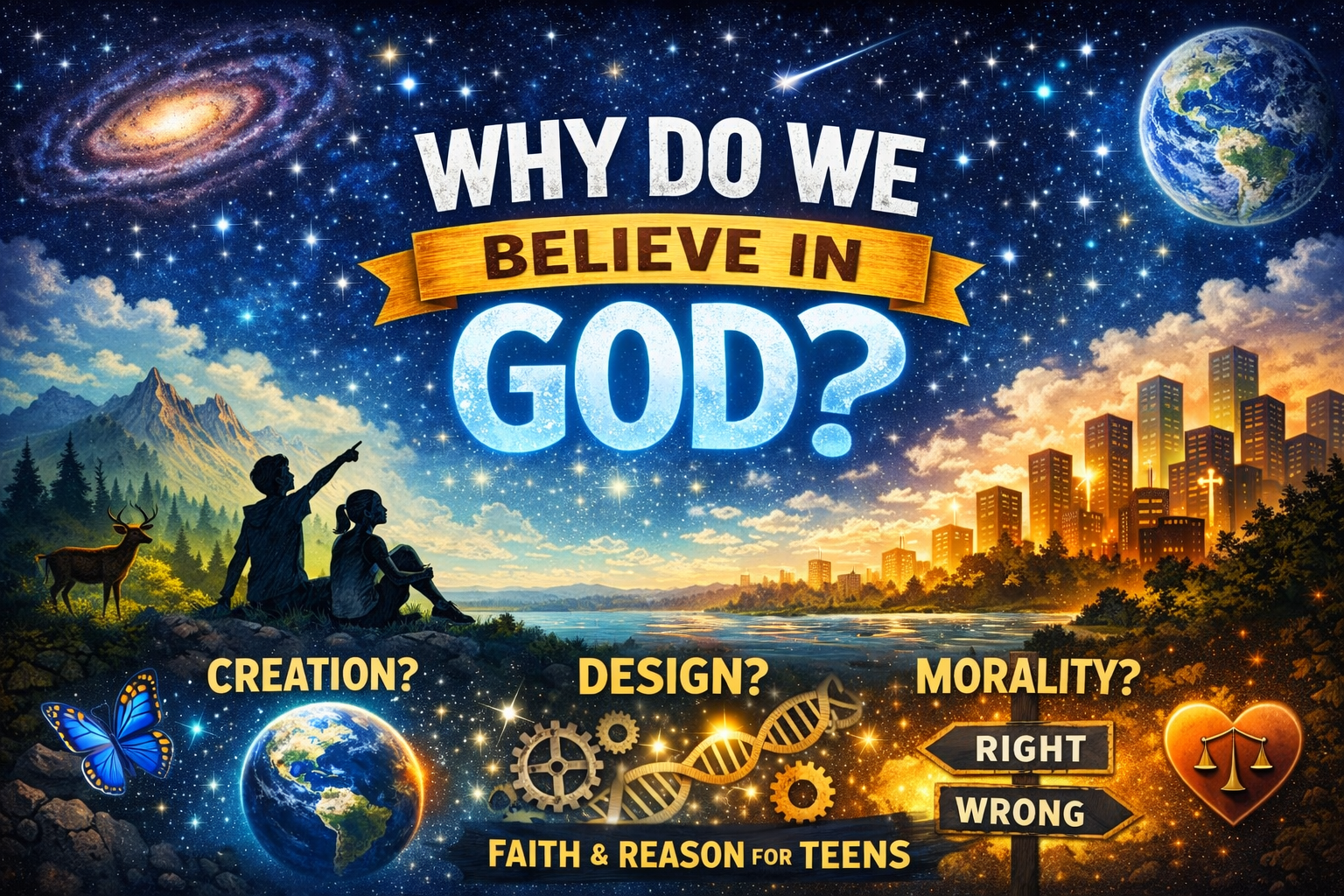
Family Devotion #1 (Read Hebrews 11:1-3)
If you’ve ever spent time around little kids, you know one of their favorite questions is “Why?”
Why is the sky blue?
Why do dogs bark?
Why do I have to eat vegetables?
Kids are curious. Their minds are always working, soaking up information like a sponge. At first, parents love this curiosity. But after the hundredth “why,” it can get a little tiring!
But here’s the thing: asking “why” doesn’t stop when we grow up. As we get older, our questions actually get bigger. We start asking things like:
Why are we here?
Does God really exist?
Is there meaning to life, or is it all random?
Those are important questions, and God is not afraid of them.
Faith and Reason Go Together
You might have been asked, “Why do you believe in God?” That can feel exciting, but also a little intimidating. After all, we can’t see God with our eyes. We believe in Him by faith, and many of us know He is real because we’ve experienced His love personally.
But Christianity is not just about feelings. It is also a reasonable faith. There are clues, what some have called “fingerprints,” all around us that point to God’s existence. The Bible never tells us to stop thinking. In fact, loving God includes loving Him with our minds.
Some people assume that faith is only for the uneducated or superstitious, but that simply isn’t true. Many of the greatest thinkers in history believed in God and gave thoughtful reasons for that belief. Looking at those reasons doesn’t replace faith but can strengthen it and help us explain what we believe to others.
Author Timothy Keller puts it this way: “even though we can’t prove God’s existence the way we prove a math problem, there are strong clues pointing to Him everywhere.”
Let’s look at three of those clues.

First Clue: Only God Could Create the Universe from Nothing
Look up at the night sky sometime. Think about the stars, the galaxies, and how massive the universe is. It naturally leads to the question: How did all of this get here?
This question is behind what’s called the cosmological argument, which is based on three simple ideas:
- Everything that begins to exist has a cause.
- The universe began to exist.
- Therefore, the universe must have a cause.
That first point makes sense to almost everyone. Things don’t just pop into existence on their own. A cup of coffee doesn’t magically appear on your desk. You have to make it. In science, one of the most basic assumptions is that events have causes.
What about the universe itself? Scientists have discovered that the universe is expanding, and that stars are slowly using up their energy. That means the universe can’t be eternal. If it had existed forever, the stars would have burned out long ago.
When scientists rewind the universe backward, everything points to a moment when time, space, and matter all came into existence at once. Some people call this a Big Bang. The Bible calls it creation.
Genesis 1:1 says, “In the beginning God created the heavens and the earth.”
If time and space had a beginning, then whatever caused them must exist outside of time and space. That cause must be incredibly powerful. That sounds a lot like God.
Think of a fireworks show. The explosions of light don’t just happen on their own. Someone lights the fuse. In the same way, the universe didn’t explode into existence by accident. God spoke, and everything came into being.

Second Clue: Only God Could Design the Universe for Life
Another clue pointing to God is the fine-tuning of the universe.
For life to exist, countless conditions had to be just right. Gravity is strong enough to hold us on the earth, but not so strong that it crushes us. Earth is the perfect distance from the sun: not too hot, not too cold. The oxygen level in our atmosphere is exactly what we need to breathe.
If any of these values were slightly different, life wouldn’t be possible. The odds of all of this happening by chance are unbelievably small.
It’s like walking into a room and seeing thousands of dials, each one set perfectly. You wouldn’t assume that happened by accident. You’d assume someone adjusted them on purpose.
The same is true when we look at the human body. The brain alone is more complex than the most advanced computer. It controls breathing, movement, memory, emotions, and thought all at once. Scripture says, “I am fearfully and wonderfully made” (Psalm 139:14).
Design points to a designer.
If you found a watch on the ground, you wouldn’t think it assembled itself. You’d know someone made it. The human body is far more complex than a watch, so it makes far more sense to believe we were created by an intelligent God.

Third Clue: Only God Can Explain Right and Wrong
There’s one more clue we can’t ignore: our sense of right and wrong.
Across cultures and throughout history, people have known that things like murder, stealing, and lying are wrong—and that love, kindness, and fairness are good. We don’t always live up to this standard, but we know it’s there. That voice inside us is called conscience.
Some people say morality is just personal opinion, but that doesn’t work in real life. If someone steals your phone, you don’t say, “Well, that’s your truth.” You say, “That’s wrong.”
If there is a moral law, there must be a moral lawgiver.
The Bible says God has written His law on our hearts (Romans 2:15). Justice, goodness, and human dignity all flow from His character. If there were no God, there would be no solid reason to care about justice at all. We would just be animals trying to survive.
But we do care. We know something is broken in this world, and we long for things to be made right. That longing points us back to God.
So… What Do We Do with This?
These reasons don’t replace the gospel. Only Jesus, through His death and resurrection, can save us from sin. And only the Holy Spirit can change a heart.
But these arguments do show that Christianity is not foolish or irrational. Believing in God actually makes sense of the world we live in.
When we honestly weigh the evidence, we discover that faith isn’t a blind leap. It’s a thoughtful trust. Creation itself whispers, “God made me.”
If you’re willing to ask “why” with an open heart, you may find that God has been answering all along.
Discussion Questions
- When you look at nature (stars, animals, weather), what makes it hard to believe it all happened by accident?
> Look up: Psalm 19:1
> What does creation tell us about God? - Why is it important that the universe had a beginning?
> Look up: Genesis 1:1
> What does this verse say about who started everything? - What is something about your body or mind that shows you were made on purpose?
> Look up: Psalm 139:14
> How does knowing God made you change how you see yourself? - How do you know when something is wrong—even if no one tells you?
> Look up: Romans 2:15
> What does this verse say about where our sense of right and wrong comes from? - If God really made and cares about the world, how should that affect the way we treat others this week?
> Look up: Micah 6:8
> What does God ask His people to do?
For deeper study…
- Systematic Theology, Wayne Grudem. Chapter 9: “The Existence of God”
- A Dispensational Theology, Charles F. Baker. Chapter 16: “Philosophical Arguments for the Existence of God”
Comments
2 responses
great study ….. thanks …..
great study ….. thanks …..