
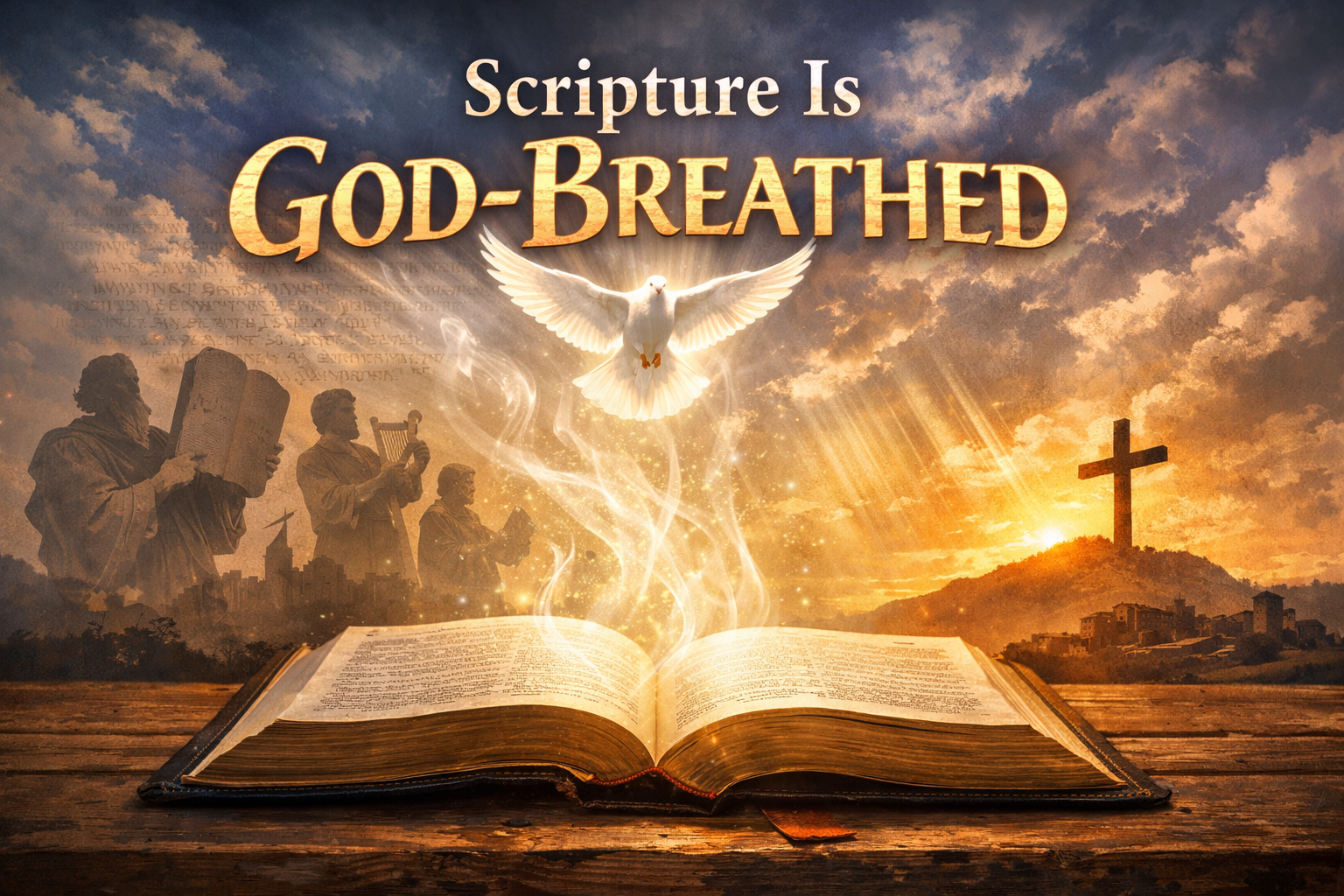
Family Devotion #3 (2 Timothy 3:14-17)
We used to read a lot of children’s books, when the kids were younger. Many of those books have a short section at the end that talks about the author: who they are and where they got the idea for the story. One author might say, “I got this idea while walking through a park,” or “This story was inspired by something that happened to me as a kid.”
That makes sense for storybooks. But it raises an important question about the Bible:
Where did the Bible come from?
Who wrote it?
And why should we trust it?
Those questions matter because the Bible isn’t just a story. It talks about God, life, right and wrong, salvation, eternity, and Jesus. If we’re going to build our lives on it, we need to know whether it’s reliable.
Whenever you want to know if something is trustworthy (whether an article, a video, or a post online) you ask, “Who said this, and how do they know?” The same is true for the Bible. If the Bible is just human opinions, we can take it or leave it. But if God is the source, then what it says matters deeply.
That’s exactly what Scripture claims about itself.
What Does “Inspired by God” Mean?
Our main verse says:
“All Scripture is inspired by God and is profitable for teaching, for reproof, for correction, and for training in righteousness.” (2 Timothy 3:16)
The phrase “inspired by God” literally means “God-breathed.”
That doesn’t mean the Bible is just inspiring (though it is). It means that God breathed out His message through human writers.
Think of it this way: a trumpet can’t make music on its own. It needs someone to breathe into it. When the right person does that, beautiful music comes out. In the same way, the writers of the Bible were the instruments, but God was the musician.

The Bible was written by many different people: shepherds, kings, fishermen, doctors, and farmers. It was composed over more than 1,500 years. They lived in different places and had different personalities and writing styles. And yet the Bible tells one unified story:
- Humanity’s sin
- God’s rescue plan
- Jesus as our Savior
That doesn’t happen by accident. The Holy Spirit guided them so that what they wrote was exactly what God wanted written.
What Inspiration Does Not Mean
It’s important to clear up a few misunderstandings.
- The writers weren’t robots.
God didn’t usually dictate every word while they wrote. They used their own language and style, but God guided the final result. - The writers weren’t perfect people.
Moses doubted himself. Peter denied Jesus. Paul persecuted Christians before he met the Lord. God used imperfect people to communicate a perfect message. - They didn’t know everything.
Prophets often didn’t fully understand how their words would be fulfilled. But God did.
Inspiration means that God spoke through his prophets and apostles. As a result the message is trustworthy, true, and authoritative.
As Peter wrote: “Men spoke from God as they were carried along by the Holy Spirit.” (2 Peter 1:21)

All of the Bible Is God’s Word
Notice that 2 Timothy says “All Scripture” is inspired, not just the parts we like.
That means:
- Not just encouraging verses
- Not just the words of Jesus in red
- Not just the New Testament
From Genesis to Revelation, the entire Bible is God’s Word.
We don’t get to say, “I like the parts about love, but I’ll ignore the parts about sin,” or “This verse makes me uncomfortable, so it doesn’t count.” We need both encouragement and correction if we want to grow.
Jesus Himself treated all of Scripture this way. He quoted the Old Testament constantly and said, “Scripture cannot be broken.” He trusted not just the message, but even the specific words.
If the Bible were partly true and partly false, we’d never know what to trust. It would be like receiving a stack of money and being told some bills are fake. God is a God of truth. He wouldn’t give us a book we can’t rely on.
The Bible doesn’t just contain God’s Word. It is God’s Word.
Why This Matters for Your Life
Because the Bible is God-breathed, it is powerful.
Scripture:
- Teaches us what is true
- Shows us when we’re wrong
- Corrects our thinking
- Trains us to live in a way that honors God
That’s why sometimes a verse feels like it’s speaking directly to you. God uses His Word to meet us right where we are whether we need comfort, conviction, or direction. No other book does that.
Final Thoughts
The Bible is not just an ancient book or a religious tradition. It is God speaking to us.
Yes, humans wrote the words, but God is the author behind them all. Because of that, we can trust Scripture, listen to it, and build our lives on it.
When you read the Bible, don’t approach it like homework. Approach it like a conversation. A good prayer before reading is simply:
“Speak, Lord. I’m listening.”
God still speaks through His Word, and He uses it to change lives.
Discussion Questions…
1. Why does it matter where the Bible comes from?
- Read: 2 Timothy 3:16–17
- How would your view of the Bible change if it were just human opinions instead of God’s Word?
2. The Bible was written by many different people over a long time, why do you think it still tells one main story?
- Read: Luke 24:44–45
- What does this tell us about God’s role in the writing of Scripture?
3. Are there parts of the Bible that are harder for you to accept or understand?
- Read: Hebrews 4:12
- Why do you think God’s Word sometimes challenges or exposes things in us?
4. Have you ever read a verse that felt like it was speaking directly to something in your life?
- Read: Psalm 119:105
- How can God use Scripture to guide us in real-life situations?
5. If the Bible really is God speaking to us, how should that affect the way we read it?
- Read: James 1:22
- What does this verse say about the connection between hearing God’s Word and living it out?
For further study…
- Systematic Theology, Wayne Grudem. Chapter 4: “Four Characteristics of Scripture: Authority”
- A Dispensational Theology, Charles F. Baker. Chapter 7: “Inspiration”