
Family Devotion #4 (Proverbs 30:5-6)
Sometimes people ask us for proof. A few years ago, I applied for a passport in preparation for a mission trip. The process wasn’t complicated, but very specific. I had to fill out an application, make an appointment, and bring required documents to prove I really am who I say I am. They didn’t just take my word for it. I had to show my birth certificate and driver’s license. After everything was checked, verified, and approved my passport arrived in the mail.
That makes sense. Traveling to another country is a big deal, and they want to be sure your identity is real.
In a similar way, people often ask an important question: “How do we know the Bible is really God’s Word?” In our previous post, we learned that the Bible is inspired by God,“ or “God-breathed” (2 Timothy 3:16). That means God spoke through real people, his prophets and apostles, using their own personalities and writing styles to write exactly what He wanted to communicate.
The Bible claims to be trustworthy, authoritative, and without error. That’s a big deal. Think twice before dismissing the Bible as just another religious book, like all the rest.
Proverbs 30:5 says, “Every word of God is tested; He is a shield to those who take refuge in Him.” The psalmist tells us that God’s Word has been examined, challenged, and has proven reliable.

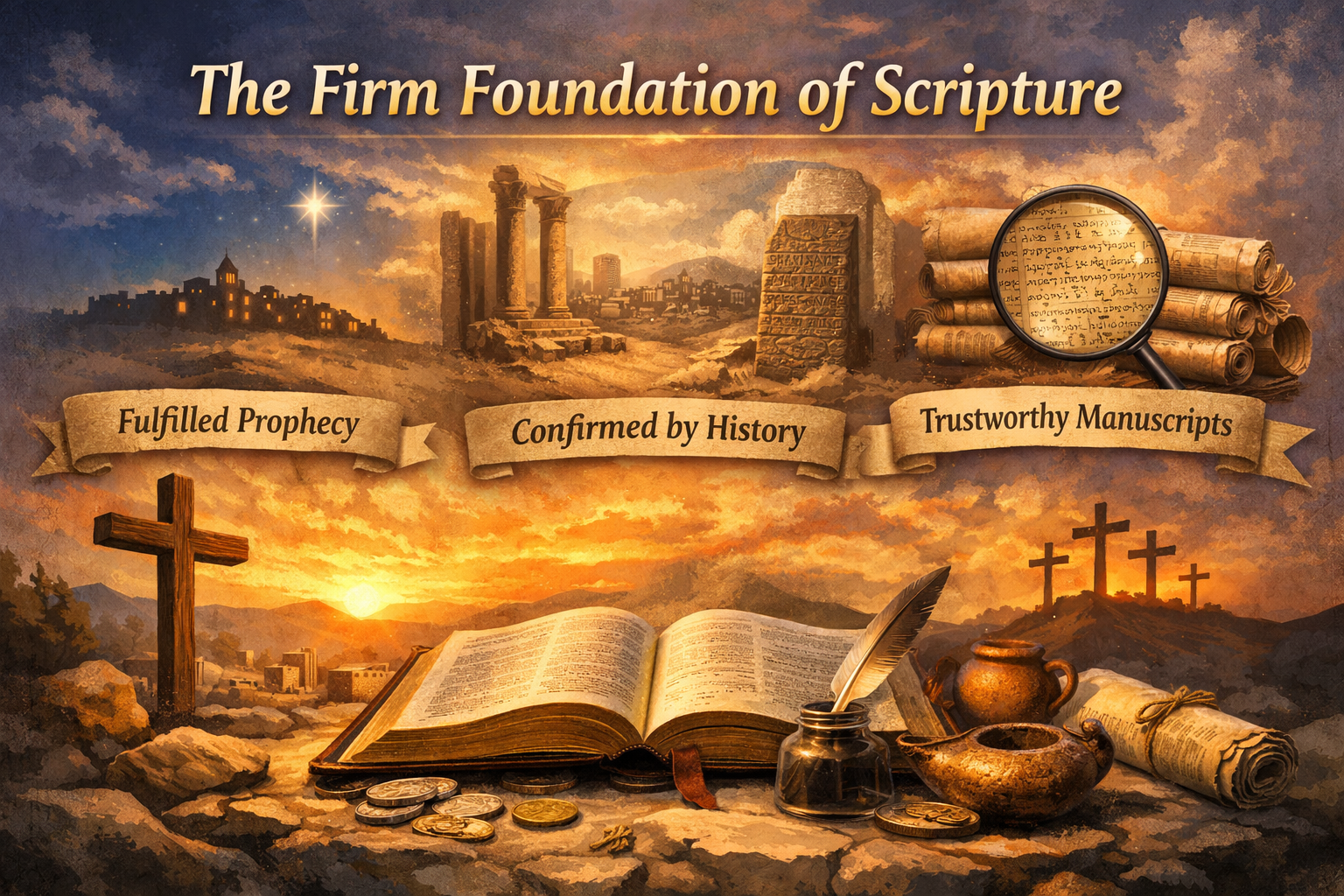
Let’s look at three strong reasons we can trust the Bible.
The Bible Contains Fulfilled Prophecy
In Isaiah 46:9–10, God says that He declares “the end from the beginning.” In other words, He knows the future before it happens.
The Bible contains many prophecies, predictions about future events recorded decades or centuries before those events took place. In fact, about one-quarter of the Bible was prophetic when it was written. God told Abraham he would have a son in old age. He told Moses He would deliver Israel from slavery. He told kings about empires that would rise and fall long before it happened.
Why does God do this? One reason is to remind us that nothing surprises Him. Another reason is to show us that His Word is true.
Many prophecies point directly to Jesus. For example, Micah 5:2 predicted that the Messiah would be born in Bethlehem, a small and unimportant town. Nearly 750 years later, Jesus was born in that very place, exactly as promised.
Psalm 22 describes someone who would be mocked by the crowd, whose hands and feet would be pierced, and whose clothes would be divided by casting lots. David wrote those words 1,000 years before Jesus, yet they clearly describe the crucifixion. These details weren’t vague guesses. They were specific, and perfectly fulfilled.
Hundreds of prophecies about Jesus were fulfilled in His life, death, and resurrection. The odds of that happening by accident are unbelievably small. Fulfilled prophecy is a powerful evidence that the Bible truly comes from God.
The Bible Is Confirmed by History
The Bible more than a spiritual book. it also records real historical events.
Luke begins his Gospel by explaining that he carefully investigated eyewitness accounts so that his readers would know the truth about Jesus (Luke 1:1–4). The Bible tells the story of real people, real places, and real events that happened in history.
Over time, archaeology has confirmed many of these details. For example, ancient records from the Assyrian Empire describe King Hezekiah of Judah and an invasion of Jerusalem, events also recorded in the Bible (2 Kings 18–19). The Bible even includes details that enemy kings left out, such as how God rescued His people.
When it comes to Jesus, we also have non-Christian historical sources that mention Him. Writers like Josephus, a Jewish historian, recorded that Jesus lived, was crucified under Pontius Pilate, and that His followers claimed He rose from the dead. Roman officials and philosophers also wrote about early Christians and their beliefs.
These writers weren’t trying to promote Christianity. They were simply reporting what they saw and heard. Their “reluctant testimony” confirms that Jesus truly lived and that His followers believed the resurrection was real.
No serious historian denies the fact that Jesus existed. The evidence is simply too strong.

The Bible Has Been Faithfully Preserved
Jesus said in Matthew 24:35, “Heaven and earth will pass away, but My words will not pass away.” That’s an incredible promise.
So how do we know the Bible we read today is the same message originally written?
In the Old Testament, scribes copied Scripture by hand with extreme care. They counted letters and words checking their work. If a copy didn’t match perfectly, they started over.
In 1947, the Dead Sea Scrolls were discovered. These ancient manuscripts were over 1,000 years older than previously known copies of the Old Testament. When scholars compared them to modern Bibles, they found the text was virtually identical. God’s Word has been preserved.
The New Testament evidence is even stronger. We have thousands of early manuscripts, far more than any other ancient book. Some copies were made just decades after the originals were written. While there are small differences in spelling or grammar, no Christian belief is affected.
God has clearly kept His promise to preserve His Word.
Conclusion
Just like I had to provide evidence to receive my passport, it’s fair to ask for evidence that the Bible is truly God’s Word. When we look honestly at prophecy, history, and preservation, we find extremely compelling reasons to embrace the Scriptures.
However, best way to know the Bible is to read it. God speaks through His Word, and He invites us to delight in its message.
“Every word of God is tested; He is a shield to those who take refuge in Him.”
—Proverbs 30:5
Family Discussion Questions
- Which fulfilled prophecy about Jesus stands out to you the most, and why? Read: Micah 5:2 and Psalm 22:16–18
- How does knowing the Bible is connected to real history affect your confidence in it? Read: Luke 1:1–4
- Why do you think God cared so much about preserving His Word accurately over thousands of years? Read: Matthew 24:35
- What is one practical way you can take delight in God’s Word this week? Read: Psalm 119:105
Comments
One response
….. very ….. good …. thanks ….Trent …